

2026 Hyundai Kona Electric or Hyundai IONIQ 5: Which EV Is Right for British Columbia?
2026 Hyundai Kona Electric or Hyundai IONIQ 5: Which EV Is Right for British Columbia?
Posted on July 8, 2026
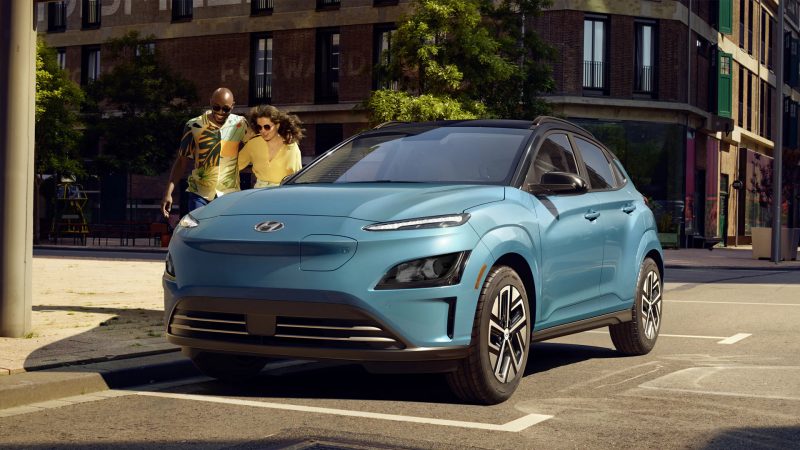
British Columbia drivers looking at Hyundai’s electric lineup usually land on the same question: go compact and simple with the Kona Electric, or step up to the roomier IONIQ 5? Both are battery-electric SUVs, but they are built around very different footprints, and the right one depends less on price and more on how you actually use a vehicle day to day.
This guide lines up the two side by side, from charging habits to cargo space, so you can see where each one earns its keep.
Kona Electric vs IONIQ 5: Specs at a Glance
| Spec | Kona Electric (Preferred) | IONIQ 5 (Preferred Long Range) |
| Drivetrain | Single-motor FWD | Single-motor RWD standard; Dual Motor AWD available |
| Motor output | 201 hp / 188 lb-ft | 225 hp / 258 lb-ft (320 hp / 446 lb-ft with AWD) |
| Battery capacity | 64.8 kWh | 84 kWh |
| Electric range | 420 km | 504 km (463 km with AWD) |
| Level 2 charge time | About 6 hours | 7 hours 20 minutes |
| Cargo, behind rear seats | 723 L | 745 L |
| Cargo, seats folded | 1,803 L | 1,655 L |
| Ground clearance | 151 mm | 155 mm |
| Curb weight | 1,705 to 1,765 kg | 1,985 kg (2,090 kg with AWD) |
| Wheelbase | 2,660 mm | 3,000 mm |
| Overall length | 4,355 mm | 4,655 mm |
Power, Range, and Everyday Charging
The Kona Electric runs a single front-mounted motor making 201 hp and 188 lb-ft of torque, paired with a 64.8 kWh battery good for 420 km of range. Its 10.8 kW onboard charger supports DC fast charging that brings a 10-80% top-up to about 43 minutes, with a full Level 2 charge taking roughly six hours.
The IONIQ 5 starts with a larger 84 kWh battery and a single rear-mounted motor rated at 225 hp and 258 lb-ft, stretching range to 504 km. An available Dual Motor AWD setup raises output to 320 hp and 446 lb-ft for extra traction, though range drops to 463 km. Its NACS charge port, with CCS adapters included, and 10.9 kW onboard charger support a Level 2 charge in about 7 hours 20 minutes given the larger pack.
For a commuter doing loops around town, the Kona Electric’s smaller battery charges faster at home and its 420 km range covers most weekly driving without a second thought. For someone who regularly drives longer distances or wants extra grip for BC’s mountain routes, the IONIQ 5’s bigger battery and optional AWD change the equation.
Cabin Space and Cargo for Real Life
At 4,355 mm long on a 2,660 mm wheelbase, the Kona Electric is sized for tight parking and easy manoeuvring. Cargo space runs 723 L behind the rear seats and 1,803 L with them folded, helped by a dual-level cargo floor that keeps groceries and gear from sliding around.
The IONIQ 5 stretches to 4,655 mm long with a considerably longer 3,000 mm wheelbase, which translates into noticeably more front and rear passenger room. Cargo behind the rear seats measures 745 L, slightly ahead of the Kona, though maximum space with the seats folded comes in at 1,655 L, less than the Kona’s folded figure. It also adds a front trunk for smaller items like charging cables.
For a solo commuter or a couple mostly hauling weekend bags and groceries, the Kona Electric’s compact size and tall folded cargo volume cover the basics. For a growing household that needs rear-seat room for car seats or gear on longer trips, the IONIQ 5’s longer wheelbase and cabin space are the deciding factor.
Comfort, Technology, and Driver-Assist Features
Both the Kona Electric and IONIQ 5 come with a 12.3-inch digital instrument cluster, a 12.3-inch touchscreen with built-in navigation, and Hyundai’s Bluelink connected-car system standard. The IONIQ 5 adds wireless Android Auto and Apple CarPlay, while the Kona Electric’s connects by cable.
Move up to the top packages and each model adds its own extras. The Kona Electric’s Ultimate Package brings ventilated front seats, a Bose eight-speaker system, and a surround-view monitor. The IONIQ 5’s Ultimate Package layers in a head-up display, wireless device charging, a fixed panoramic glass roof, and heated rear seats.
Standard on both models:
- Adaptive or Smart Cruise Control with Stop and Go
- Lane Keeping Assist and Lane Following Assist
- Highway Driving Assist
- Rearview camera and Blind-Spot Collision-Avoidance warning
Which Hyundai Fits Your Drive?
If your days are mostly city streets, parking lots, and short highway hops, the Kona Electric’s smaller footprint and quicker home charging make it the easier vehicle to live with. It suits solo drivers and couples who want efficient, low-fuss electric driving without paying for space they will not use.
If you’re shuttling kids, gear, or regularly driving longer stretches of highway, the IONIQ 5’s longer wheelbase, bigger battery, and available AWD make it the more versatile choice. For a small family or a first-time EV buyer who wants extra range margin, the IONIQ 5’s cabin and charge port flexibility are the deciding factor.
Either way, you’re choosing between two ends of Hyundai’s electric lineup, not settling for a compromise.
Choosing Your Next Hyundai EV
The Kona Electric and IONIQ 5 give drivers two distinct ways into electric driving, one built around compact efficiency and quick charging, the other around space, range, and available all-wheel traction for longer trips.
Visit Northland Hyundai in Prince George to see the Kona Electric and IONIQ 5 in person and get a feel for which one fits your daily routine and your next road trip.